Airbnb Turnover Cleaning Checklist for Charlotte Hosts
 By Anastasiia Serzhantova
·
·
8 min read
By Anastasiia Serzhantova
·
·
8 min read
You have an 11 a.m. checkout and a 3 p.m. check-in. That four-hour gap is your whole Airbnb turnover cleaning window, and one stray hair on the pillow or an empty toilet-paper roll can drop you from five stars to three. Guests forgive a lot. They do not forgive a bathroom that looks used.
I run turnovers across Charlotte, and the hosts who keep their ratings high all do the same thing: they follow a checklist, every stay, in the same order. No memory, no guessing. This is the turnover checklist I use, plus the small systems that make a same-day flip repeatable instead of frantic.
How fast should an Airbnb turnover clean actually take?
Plan on roughly 1.5 to 2 hours for a one-bedroom and 3 to 5 hours for a full house. On a same-day flip with an 11-to-3 window, that leaves you no slack for surprises. The fix is a set order, staged supplies, and laundry that is already moving before you touch the bathroom.
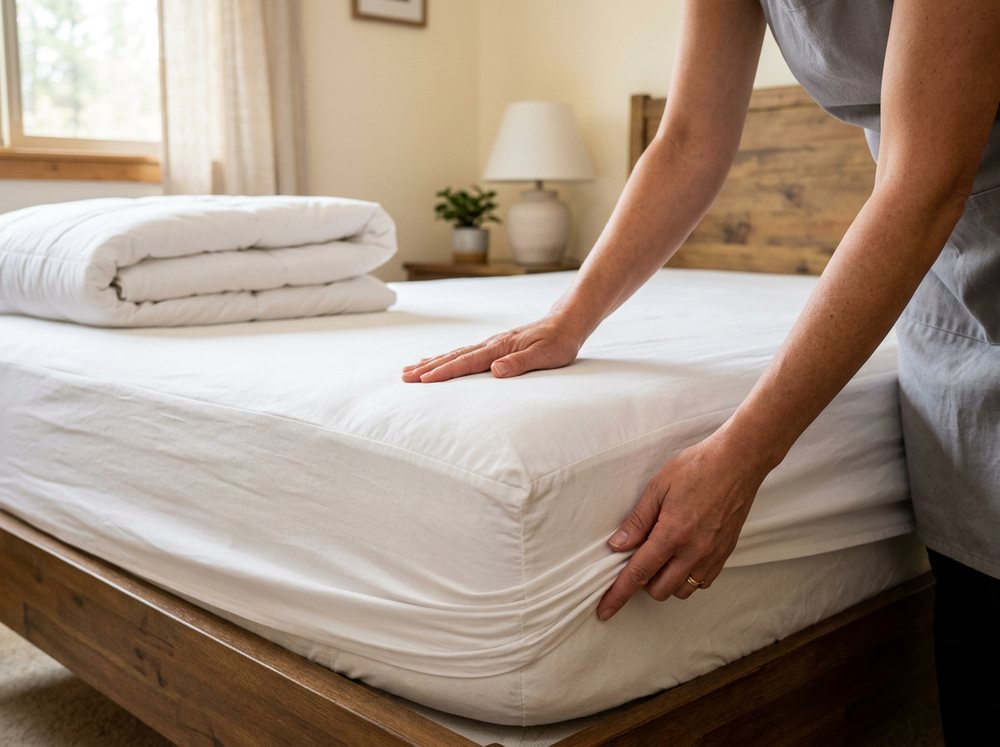
Cleanliness is the single most common thing guests mention in reviews, good and bad. Listings that hold a 4.8-plus cleanliness score tend to book more and are what Superhost status is built on. So the clock matters, but the finish matters more. Speed comes from the system, not from cutting corners.
Work in a fixed order
Every good turnover follows the same route so nothing gets skipped when you are rushing:
- Walk through first. Open windows, spot any damage, start a wash of stripped linens.
- Strip beds and gather all towels. Get that first load going immediately.
- Kitchen and dishes (they need to dry while you work elsewhere).
- Bathrooms, top to bottom.
- Bedrooms and staging.
- Floors last, every room, working toward the door.
- Restock, final photos, lock up.
The room-by-room turnover checklist we follow
Print this, laminate it, and keep it in the owner’s closet. The cleaner checks every line, every turnover. Time estimates are for a one-bedroom.
| Room | Must-do tasks | Rough time |
|---|---|---|
| Whole unit | Start laundry, empty all trash, check for damage and left-behind items, reset thermostat, straighten anything moved | 15 min |
| Kitchen | Run/empty dishwasher, wipe counters and backsplash, clean stovetop, inside microwave, sink and faucet, fridge check and toss old food, restock coffee and trash bags | 25 min |
| Bathroom | Scrub toilet (base and behind included), shower and drain, mirror, sink, restock toilet paper and toiletries, fresh towels, empty trash | 25 min |
| Bedroom | Fresh sheets made hotel-style, dust surfaces and lamps, check under the bed, style pillows, wipe nightstands and switches | 20 min |
| Living area | Fluff and straighten cushions, wipe remotes and tables, dust, tidy decor to match your listing photos | 15 min |
| High-touch pass | Disinfect switches, doorknobs, handles, faucets, remotes, and the coffee maker | 10 min |
| Floors | Vacuum all carpet and rugs, then mop hard floors toward the exit | 20 min |
Linens and laundry: your tightest constraint
Laundry is what blows up a same-day turnover. If you are washing and drying the only set of sheets on site, you are stuck standing by the dryer while the clock runs. The rule that saves you: keep two to three complete sets per bed. One is on the bed, one is clean in the closet, and one is in the wash or the laundromat.
With three sets, your cleaner strips the used linens, puts fresh ones on right away, and takes the dirty load off site. No waiting. Same math for towels: figure two bath towels and roughly four hand and wash towels per guest, always white so you can bleach out makeup and stains instead of tossing linens you paid for.
White linens also read as clean and hotel-like, and they hide nothing, which keeps your standard honest. If on-site laundry is your bottleneck, hand it off. Our off-site laundry add-on returns folded, ready-to-stage sets so the turnover never stalls at the dryer.
A five-star turnover is not about scrubbing harder. It is about a repeatable system: staged supplies, spare linens, and a checklist your cleaner runs the same way every time.
Restock to par so guests never run out
Nothing tanks a review faster than a guest finding one square of toilet paper at midnight. The way pros prevent it is par levels. A par is the minimum amount of any item you keep on hand at all times. Set each par at about 1.5 to 2 times what an average stay uses, so back-to-back bookings and a slow Amazon delivery never leave you short.
A simple restock par sheet
- Toilet paper — leave 2 rolls per bathroom out, keep a par of 8 to 12 in the closet
- Paper towels — 1 out, par of 4
- Hand soap and body wash — topped off every stay, 2 backups each
- Dish soap, sponge, dishwasher pods — refill pods to a par of 20
- Trash bags — fresh liner in every can plus spares under each
- Coffee, filters, tea, sugar — restock to a set count
- Makeup wipes and small welcome extras — the touches guests remember
Store it all in one owner’s closet, ideally locked, organized into kits: a bathroom kit, kitchen kit, and welcome kit, each holding the same items in the same amounts. A portable caddy inside the closet makes the restock a two-minute walk-through instead of a scavenger hunt. Check consumables every turnover and do a full inventory count every 90 days.
Staging and the high-touch surfaces guests judge
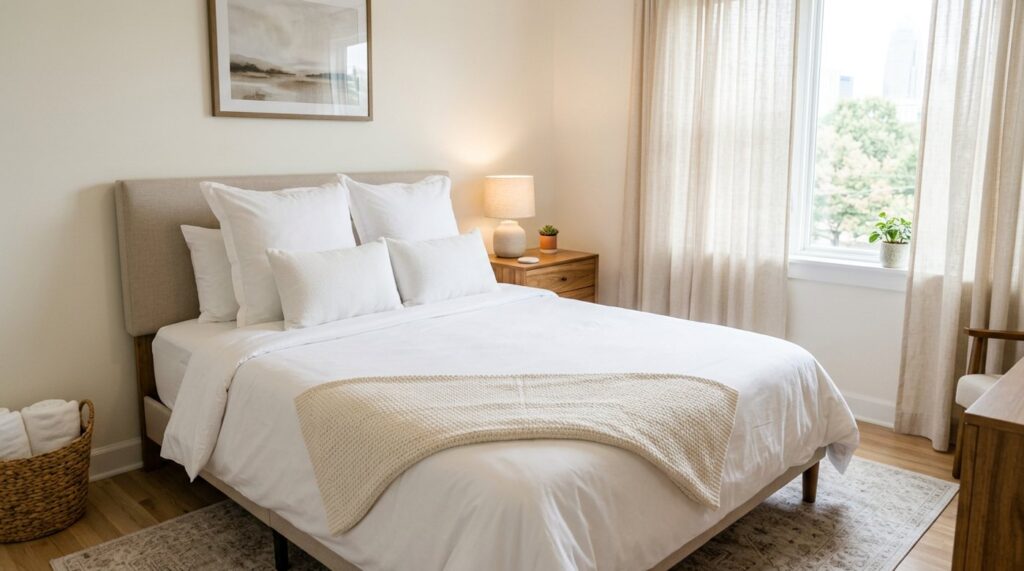
Guests decide how clean your place is in the first ten seconds, from the doorway. So the last step of every turnover is staging it to match your listing photos: crisp bed made tight, pillows styled front to back, towels folded the same way each time, blinds set, lights and thermostat welcoming. This is the part that photographs well and reads as care.
Then the surfaces people actually put their hands on. Light switches, doorknobs, faucet handles, remotes, the coffee maker, and the toilet flusher are the high-touch spots that get missed and noticed. The right order, per CDC guidance, is to clean first, then disinfect. Wipe the grime off, then hit it with an EPA-registered disinfectant and give it the full contact time on the label. For screens and remotes, a wipe with at least 70% alcohol is safer than a heavy spray.
Don’t forget the spots guests hunt for
- Hair on bathroom floors, in the shower drain, and along the toilet base
- Inside the microwave and under the stovetop grates
- Fridge shelves and the seal
- Baseboards, corners, and under the bed
- Mirror and glass, streak-free
Damage and lost-and-found: photograph first, ask later
Your cleaner is your first inspector. During the walk-through, anything broken, stained, or missing gets photographed before it is touched. Take wide shots for context and close-ups for detail. Those photos are what protect you.
Airbnb’s Host damage protection can reimburse hosts for guest damage, but the timing is strict: you generally need to file through the Resolution Center within 14 days of the damage and before the next guest checks in. No photos, no claim. Normal wear and tear is not covered, so document real damage, not a scuff.
For lost-and-found, bag and label anything left behind with the date and the reservation, and log it in your turnover notes. Guests almost always message about a phone charger or a jacket a day later, and having it tagged makes you look on top of everything.
From me: a same-day save in south Charlotte
Last spring, during a busy Charlotte race weekend, one of our hosts near the airport had a guest check out at 11 with a 3 p.m. arrival and red wine spilled across a white duvet. On a single-set property, that is a canceled turnover. This host kept three linen sets in the owner’s closet, so my cleaner stripped the stained duvet, put a clean set on within minutes, and sent the wine-stained one out with our laundry run to be treated properly.
She photographed the stain for the damage claim, restocked from the par kits, and had the place staged and guest-ready by 2:40. The guest never knew. The review said “spotless.” That save was not luck. It was spare linens, a stocked closet, and a checklist doing its job.
That is the whole point of a system. Build it once, and every turnover after runs on rails. If you would rather hand the flip off entirely, our Airbnb turnover cleaning service runs this exact checklist on every visit.
Frequently asked questions
How long does an Airbnb turnover clean take?
Budget about 1.5 to 2 hours for a one-bedroom and 3 to 5 hours for a larger home. A same-day 11-to-3 flip is doable when linens are spare, supplies are staged, and the cleaner works in a fixed order.
How many sets of sheets and towels should I keep?
Keep two to three complete linen sets per bed: one on the bed, one clean in the closet, one in the wash. Plan on about two bath towels and four hand or wash towels per guest, all white so stains bleach out.
What should I restock on every turnover?
Toilet paper, paper towels, hand soap, body wash, dish soap, dishwasher pods, trash bags, and coffee. Set a par level at 1.5 to 2 times average use and check consumables at every turnover so nothing runs out mid-stay.
What are the high-touch surfaces I need to disinfect?
Light switches, doorknobs, faucet handles, remotes, the coffee maker, and toilet flushers. Clean them first, then disinfect with an EPA-registered product and let it sit the full contact time. Use 70% alcohol wipes on screens and remotes.
How do I report guest damage on Airbnb?
Photograph the damage with wide and close-up shots before cleaning, then file through Airbnb’s Resolution Center. You generally have 14 days and need to file before the next check-in. Strong photos and repair estimates are what get claims approved.
Should I hire a cleaner or handle turnovers myself?
If you have one listing and a flexible schedule, doing it yourself is fine. Once you have back-to-back bookings or tight same-day flips, a pro who follows a set checklist protects your rating and your time. Try our instant quote calculator to see what a turnover costs.
Want your Charlotte turnovers handled the same way every time, so your reviews stay at five stars? Get in touch and we will set up a checklist and par sheet built around your listing.
Anastasiia Serzhantova is the founder of Close 2 Clean and the person who actually cleans your home — every visit, start to finish. She works solo across the Charlotte metro, from Uptown condos to family homes in Ballantyne, and writes about the practical, tested methods she uses every day: the ones that hold up in real Charlotte homes.