Hard Water Stains: Why Charlotte Homes Get Them and How to Remove Them
 By Anastasiia Serzhantova
·
·
9 min read
By Anastasiia Serzhantova
·
·
9 min read
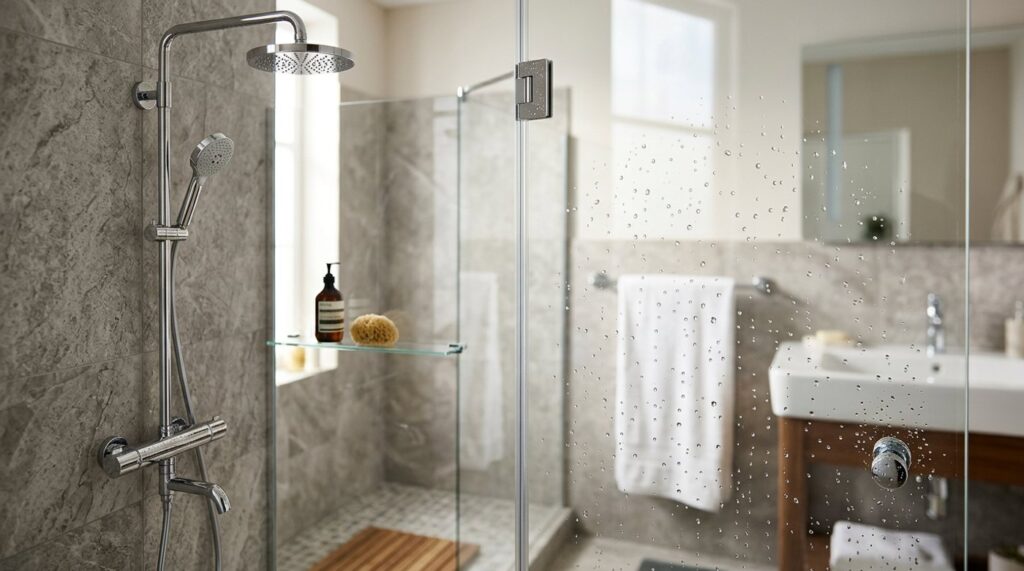
Cloudy shower glass. A crusty white ring around the faucet. A showerhead that sprays sideways because the holes are half plugged. Those chalky hard water stains turn up in Charlotte bathrooms and kitchens no matter how often you scrub. And scrubbing harder rarely helps.
Here is the part most people miss: that white film is mineral, not dirt. Soap and a sponge barely touch it. You have to dissolve it. Below is the exact playbook I use in homes from NoDa to Ballantyne, plus a few easy habits that keep the scale from coming back.
What causes hard water stains?
Hard water stains are mineral deposits, mostly calcium and magnesium, left behind when tap water dries. The water evaporates and the minerals stay put, hardening into chalky white scale. Charlotte’s water sits on the softer end of the scale, but even light mineral content stacks up on glass, metal, and porcelain over months.
Why do Charlotte homes get them?
Charlotte Water pulls most of its supply from the Catawba River chain, mainly Mountain Island Lake and Lake Norman up in north Mecklenburg County. As that water moves through rock and soil, it picks up a small load of dissolved calcium and magnesium along the way.
By the numbers, Charlotte’s tap water usually lands around 2 to 4 grains per gallon, roughly 34 to 68 parts per million, according to Charlotte Water’s own quality reports. That puts us at the soft to moderately hard border. The USGS scale calls anything under 60 mg/L soft and 61 to 120 mg/L moderately hard.
So why do you still see spots? A few reasons:
- Evaporation concentrates the minerals. A single drop looks like nothing. Thousands of drops drying on the same spot leave a visible crust.
- Heat speeds it up. Water heaters, kettles, and dishwashers push minerals out of solution faster, so scale grows quicker inside appliances than on a cool countertop.
- Older fixtures hold it. Pitted chrome and worn caulk give scale something to grab.
- Wells run harder. If you are on a private well in the outer county rather than city water, your hardness can be much higher.
Bottom line: our water is not brutal, but it is not stain proof either. Give it time and a warm, wet surface, and it will leave its mark.
Where do hard water stains show up first?
Some spots crust over faster than others. These are the ones I flag on almost every visit.
- Shower glass and doors. The classic foggy, spotted look that will not wipe clear.
- Faucets and fixtures. White rings at the base and around the spout, plus dull, filmy chrome.
- Showerheads. Plugged nozzles that spray in odd directions or drip long after you shut the water off.
- Toilet bowls. A ring at the waterline and streaks below it, often gray or rust tinted.
- Dishwashers and kettles. Cloudy glassware, a gritty film on the tub, and scale flakes in the bottom of the kettle.
How do you remove hard water stains safely?
Two everyday acids do most of the work: white vinegar and citric acid powder. Both dissolve mineral scale without harsh fumes. Match the method to the surface and you will not have to scrub hard at all.
Quick reference by surface
| Surface | Safe method | Avoid |
|---|---|---|
| Shower glass | 1:1 white vinegar and water spray, 10 to 15 minutes, then squeegee | Steel wool, abrasive powders |
| Chrome faucets | Vinegar-soaked cloth wrapped around the fixture, 15 to 30 minutes | Scouring pads, gritty scrubs |
| Showerhead | Soak in white vinegar 30 to 60 minutes (bag trick) | Leaving vinegar on brass or nickel plating over 30 minutes |
| Porcelain toilet bowl | Vinegar dwell, then a wet pumice stone for the stubborn ring | Pumice on any other surface |
| Dishwasher | Citric acid powder, hot empty cycle | Mixing with any bleach product |
| Natural stone (marble, travertine, granite) | Mild pH-neutral cleaner and a soft cloth only | Vinegar, citric acid, any acid |
Shower glass and chrome
Mix equal parts white vinegar and water in a spray bottle. Mist the glass and fixtures, let it sit 10 to 15 minutes so the acid can work, then wipe with a microfiber cloth and squeegee the glass dry. For a thick haze, soak a cloth in straight vinegar and press it flat against the spot for half an hour before wiping.
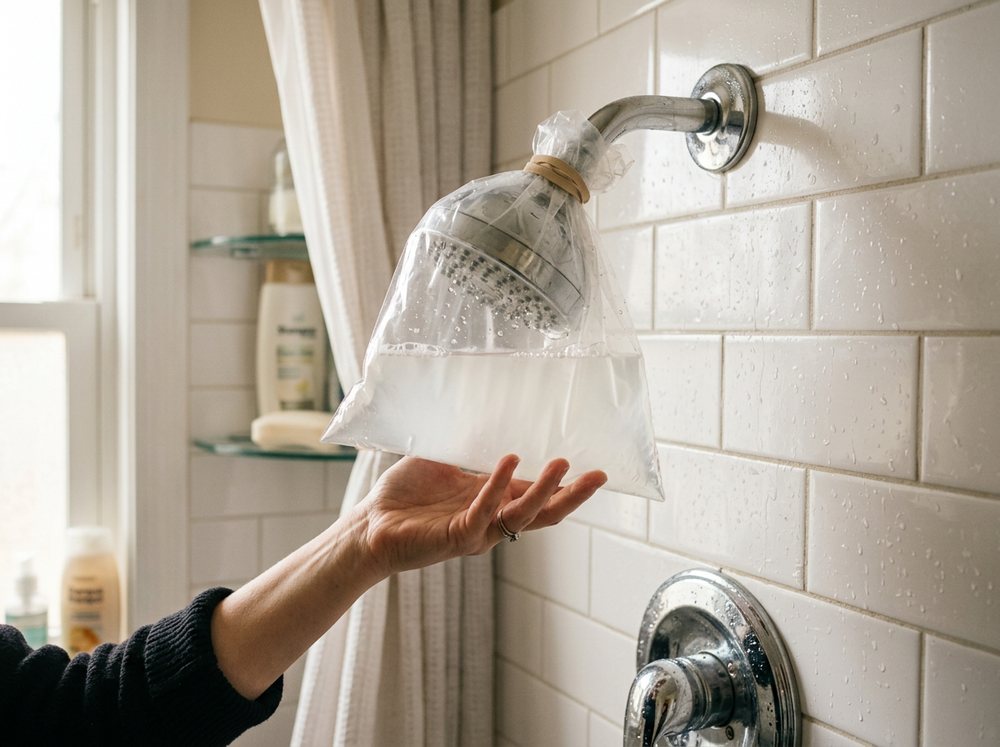
The showerhead bag trick
This one is a favorite of mine because you do not even have to remove the head.
- Fill a sturdy sandwich bag or freezer bag with white vinegar.
- Slip it over the showerhead so the nozzles are fully submerged.
- Tie it in place with a rubber band or twist tie.
- Let it soak 30 to 60 minutes. For heavy scale, a few hours works, but skip overnight on gold, brass, or nickel finishes, which acid can strip.
- Remove the bag, run hot water, and scrub any leftover flecks with an old toothbrush.
Toilet bowl rings
Pour a cup or two of white vinegar into the bowl, let it dwell 20 to 30 minutes, and scrub with the brush. For a hardened ring that will not budge, a wet pumice stone rubbed gently on the porcelain lifts it. One rule, no exceptions: pumice belongs on porcelain toilets and nowhere else. It will scratch glass, chrome, acrylic, and stone.
Dishwashers and kettles
Put 3 to 4 tablespoons of citric acid powder in the detergent cup, close it, and run the hottest cycle with the machine empty. Follow with a normal wash. For a kettle, fill it with a 1:1 vinegar and water mix, bring it to a boil, let it stand 20 minutes, then rinse well. Descaling every one to three months keeps buildup from ever getting bad.
Minerals, not dirt. Dissolve the deposit, do not fight the surface. That single shift saves your glass, your chrome, and your knuckles.
What should you never do?
A few moves turn a small stain into permanent damage or a safety problem. Skip these every time.
- Never mix vinegar with bleach. Acid plus bleach releases chlorine gas, which irritates your eyes, throat, and lungs. The Washington State Department of Health warns against it plainly. Pick one product and rinse well before you switch.
- No acid on natural stone. Marble, travertine, limestone, and many granites etch on contact with vinegar or citric acid. You get a dull, rough patch that no amount of polishing fixes. Use a pH-neutral stone cleaner instead.
- No abrasive pads on glass or chrome. Steel wool and scouring powder leave micro-scratches that trap even more scale next time.
- Test first. On a colored finish, an old fixture, or anything you are unsure about, try your cleaner on a hidden corner before you commit.
From me: the Plaza Midwood shower
A client in Plaza Midwood called us about a frameless glass shower she was ready to replace. She had been scrubbing it weekly with an all-purpose spray, and it only got cloudier. She figured the glass was etched for good.
It was not etched. It was layered scale. I misted the panels with a 1:1 vinegar solution, let it dwell about 15 minutes, and wiped from the top down while a second pass soaked the worst corner. The glass came back clear enough to see the tile grout behind it. We finished with a squeegee and handed her one to keep in the shower. On our next visit six weeks later, the glass was still clean. No new panel needed, just the right method and a 30 second habit.
How do you keep hard water stains from coming back?
You will never fully stop mineral scale without a whole-home water softener, but you can slow it to a crawl with small habits. These are the ones we teach every client.
- Squeegee the glass. Ten seconds after each shower removes the water before it can dry into spots. This is the single highest payoff habit.
- Rinse and dry fixtures. A quick wipe of the faucet and handles after washing up keeps chrome shiny.
- Run the fan. Good airflow dries surfaces faster, so minerals have less time to settle.
- Descale on a schedule. Hit the showerhead, dishwasher, and kettle every one to three months before scale gets thick.
- Do a light acid wipe weekly. A fast pass with your vinegar spray stops buildup long before it hardens.
If keeping up with it all feels like a lot, that is exactly where a routine standard cleaning earns its keep. We treat the fixtures and glass every visit, so scale never gets a foothold.
Frequently asked questions
Is Charlotte tap water actually hard?
It is on the softer side, usually around 2 to 4 grains per gallon per Charlotte Water’s reports, which reads as soft to moderately hard. That is gentler than many US cities, but it still carries enough calcium and magnesium to leave scale over time, especially on hot, wet surfaces.
Does vinegar damage anything?
Yes, on the wrong surface. Vinegar is safe on glass, chrome, porcelain, and tile, but it etches natural stone like marble and travertine and can strip brass or nickel plating if left on too long. Keep soaks under 30 minutes on plated finishes and never use it on stone.
Will a pumice stone scratch my toilet?
Used wet on a porcelain bowl, a pumice stone lifts the ring without scratching. Keep both the stone and the surface soaked so it glides. Never use pumice on glass, metal, acrylic, or stone, where it will leave permanent marks.
What is the fastest fix for cloudy shower glass?
A 1:1 white vinegar and water spray. Mist the glass, wait 10 to 15 minutes, wipe with microfiber, and squeegee dry. For thick haze, press a vinegar-soaked cloth against the glass for half an hour first.
Can I use bleach on hard water stains?
Bleach whitens and disinfects, but it does not dissolve minerals, so it will not clear scale. More important, never mix it with vinegar or any acid, which produces toxic chlorine gas. Reach for an acid to remove hard water stains, not bleach.
How often should I descale my dishwasher?
Every one to three months for Charlotte water. Run 3 to 4 tablespoons of citric acid in the detergent cup on a hot, empty cycle. It clears the film that dulls your glassware and keeps the machine draining well.
Ready for a spot-free bathroom and kitchen?
Book a bathroom add-on or a kitchen add-on and we will handle the scale on your glass, fixtures, and appliances for you. Not sure what it runs? Get a fast, no-pressure quote with our price calculator.
Anastasiia Serzhantova is the founder of Close 2 Clean and the person who actually cleans your home — every visit, start to finish. She works solo across the Charlotte metro, from Uptown condos to family homes in Ballantyne, and writes about the practical, tested methods she uses every day: the ones that hold up in real Charlotte homes.